Hello everybody, welcome to my recipe page, If you're looking for new recipes to try this weekend, look no further! We provide you only the perfect All-Purpose Dengaku Miso Sauce recipe here. We also have wide variety of recipes to try.
Before you jump to All-Purpose Dengaku Miso Sauce recipe, you may want to read this short interesting healthy tips about {The Simple Ways to Be Healthy. Getting A Healthy Eater
Healthy self esteem originates in the environment located at the: family, school, peer group, work place, and neighborhood. There are particular features of your environment that have to be current in order for self esteem to be sabotaged and grow.
The main part of a healthy environment for self respect is the fact that it needs to be nurturing. It should provide incomparable warmth, love, and caring. It ought to provide the realization that other people are known as worthy to be cultivated, reinforced, rewarded, and ensured to.
Healthy atmosphere for self esteem transmits messages of heat, loving, and affectionate by physical contact, meeting the survival needs of food, clothing and shelter, and offering a feeling of equilibrium and order in life.
A healthy atmosphere for self esteem ought to provide approval. It will realize the other people see each other as worthy individuals who possess a special set of personality traits, skills, abilities, and competencies making them unique. Acceptance allows people to develop relationships with other people, yet keep healthy boundaries of individuality inside themselves.
From the healthy environment for self esteem should be good communication, everyone ought to be heard and reacted to in a healthy way so that healthy problem solving is possible. Appropriate giving and receiving feedback is encouraged and rewarded. Communication at a"feelings" level is a mode of operation for all these people, allowing them to stay in touch with their emotions in a productive manner.
The healthy environment for self esteem must comprise appreciation and acceptance of people for who they are. That comprehension and acceptance shouldn’t be based on the condition that they must first conform to a prescribed standard of behavior or behavior. That can be unhealthy. Unconditional recognition and acceptance supplied in the form of service permits people to attain their greatest potential.
The healthy atmosphere for self regard ought to be clearly identified and enforced limits known to individuals without the hidden tricks or exploitation. Limits set the structure for the lives of people, allowing transparent benchmarks of appropriate and inappropriate behavior. Limits enable individuals to recognize their duties and to chart their path of behaviour in a rational way.
Respect and latitude for individual action within the specified limits of the healthy atmosphere for self esteem ought to be present as well. This encourages individuals to use their creativity, ingenuity, and imagination to become productive within the established structure. Restrictions that suppress identity can lead to a narrow focus, with people getting stunted and handicapped in the usage of their own abilities, skills, and resources.
In the end, healthy environment for self esteem ought to be bonding, which is the physical/emotional occurrence between individuals and others in their environment. This is crucial for the growth of healthy self esteem. Bonding is forming a reciprocal psychological attachment between a person and a"significant other" (parent, child, friend, fan, etc.). This includes the substantial additional giving unconditional love and support as well as developing a psychological connection between each other.
We hope you got insight from reading it, now let’s go back to all-purpose dengaku miso sauce recipe. You can have all-purpose dengaku miso sauce using 13 ingredients and 19 steps. Here is how you achieve that.
The ingredients needed to prepare All-Purpose Dengaku Miso Sauce:
- Provide For the red miso version:
- Prepare 2 tbsp Red miso
- Prepare 2 tbsp Sugar
- Provide 1 tbsp Mirin
- You need 1/2 to 2/3 tablespoon Zhi ma jiang (or use sesame paste instead)
- Get 4 tbsp Dashi stock (or use water + dashi stock granules)
- Prepare 1 Toasted sesame seeds (optional)
- Take For the white miso version:
- Get 2 tbsp Saikyo miso (or white miso)
- Provide 1/2 tbsp Sugar
- Use 1 tbsp Sake
- Take 1/2 tsp Zhi ma jiang (or use sesame paste instead)
- Prepare 3 tbsp Dashi stock (or use water + dashi stock granules)
Steps to make All-Purpose Dengaku Miso Sauce:
- Put all the ingredients except for the toasted sesame seeds into a non-stick pan.
- Bring to a boil while mixing with a spoon or spatula. When it reaches the consistency you want, turn the heat off. *I cook it for about a minute.
- Add some optional toasted sesame seeds, and the sauce is done.
- This is the white miso version of dengaku miso sauce. This is made in the same way - just follow Steps 1 and 2.
- Store any leftover dengaku miso sauce in zip bags in the refrigerator, where it will keep for quite a long time. If it's too stiff when you want to use it, thin it out with a little water as you warm it through.
- Use ths sauce on konnyaku, daikon radish, eggplants, etc. It's a mild dengaku miso sauce that goes with many things.
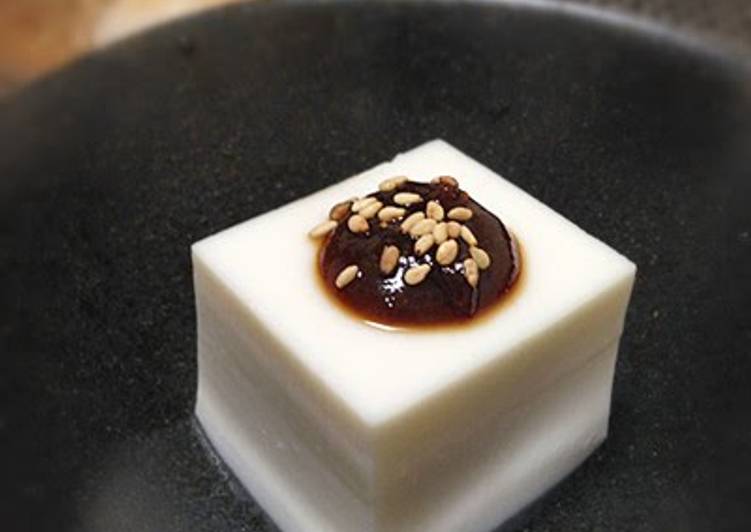
- This is nama-bu (fresh fu, wheat gluten) with dengaku sauce (see Step 19). I used both red and white miso dengaku miso sauces.
- Every household has its own way of preparing konnyaku or daikon radish with dengaku miso sauce, and here's how I do it.
- Daikon radish: Slice into 2.5cm thick rounds, and shave the edges off to round them off. Make a crisscross cut halfway through the daikon radish slice from the bottom.
- Put the daikon radish slices in a pan, and add enough of the white rinsing water from rinsing rice to cover. Cook over medium heat. *If this is too much work, you can cook the daikon radish in the microwave.
- When the pan comes to a boil, cover with a lid and simmer over low heat for 15 to 20 minutes. Drain the daikon radish when it's cooked through.
- Soak the daikon radish in ice water, and drain again.
- Put 400 ml of water, a piece of konbu seaweed for making dashi, and 1 tablespoon of sake in a pot with the drained daikon radish from Step 12. Heat over medium heat. *The amount of dengaku sauce you can make with this recipe is enough for about 4 pieces of the daikon radish.
- When the liquid in the pot starts bubbling, cover with a lid. Turn the heat down to low and simmer for 45 to 60 minutes (to your desired degree of tenderness).
- To prepare konnyaku: Cut it up into pieces of the size you like. Boil briefly to remove the odor, and drain.
- Simmer in the same way as the daikon radish as described in Steps 13 and 14.
- Cool the daikon radish in Step 14 or the konnyaku in Step 16 in their cooking liquids, to let the flavor of the dashi permeate them. Warm before serving. Serve with the dengaku miso sauce of your choice.
- is "Eggplant and Pork Stir Fry With Miso", which is flavored with this dengaku miso sauce. I highly recommend it.
- If you don't like sesame in your sauces, just leave the sesame paste out of the recipe, and you'll have regular dengaku miso sauce.
If you find this All-Purpose Dengaku Miso Sauce recipe useful please share it to your good friends or family, thank you and good luck.